The Green Table Northumberland at Humshaugh Village Hall
3rd Feb 2026
The Green Table Brings Communities Together for Climate Action in Rural Northumberland
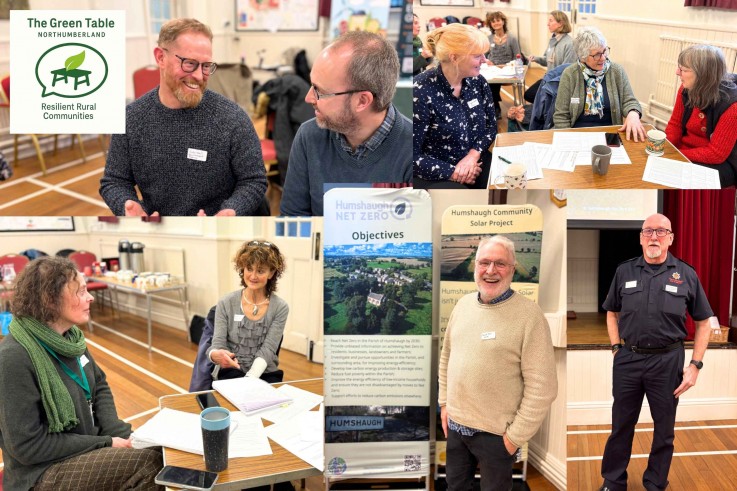
Despite the challenges posed by Storm Chandra, Humshaugh Village Hall was filled with energy, ideas and determination on Tuesday 27 January, as community groups and organisations from across the region gathered for The Green Table Northumberland — a collaborative event focused on renewable technologies, carbon reduction and protecting the rural environment.
Organised by Anna Revell and Fiona Knox on behalf of Community Action Northumberland, the event brought together a diverse mix of grassroots groups, public bodies and sector specialists, demonstrating the growing momentum behind community-led climate action in Northumberland. The event was hosted by Humshaugh Village Hall, with lunch provided by Noisette Catering, helping to create a welcoming space for open and constructive discussion.
Opening the event, Anna Revell set out the ambition behind The Green Table Northumberland series, describing it as “a series of events for organisations and community groups working for the benefit of the environment, to advance renewable technologies and carbon reduction.” She emphasised that the initiative exists to foster collaboration and knowledge sharing, “to accelerate the adoption of sustainable solutions across rural Northumberland”.
The discussion brought together representatives from a wide range of organisations, including the Environment Agency Flood Resilience Team, Northumberland National Park, Northumberland Fire & Rescue Service, Northumberland Community Energy Limited, NICRE, Acomb Community Energy, North East & Yorkshire Net Zero Hub, parish councils, eco-church groups and community-led housing and transport initiatives. The breadth of perspectives reinforced the shared understanding that tackling climate change in rural areas requires joined-up thinking and strong partnerships.
A central focus of the event was the work of Humshaugh Net Zero, with David Still outlining the group’s journey and ambitions. He explained how the initiative began in 2019 with just a small group of residents wanting to understand the scale of the challenge and what could realistically be done. “The first thing we did was find out what was the extent of the problem,” he said, describing how early community engagement during lockdown helped shape a locally grounded low-carbon study and the development of their own net-zero calculator.
Humshaugh Net Zero has since formed a community interest company and grown to more than 60 members in a parish of around 350 households. The group has supported the installation of solar panels, batteries and heat pumps in key community buildings, and has set an ambitious target to become a net-zero parish by 2030.
“We need to start from community up as well as government down, because together we can make real difference,” David told attendees.
However, he was candid about the barriers facing community energy projects, particularly around grid connections, regulation and funding. Referring to plans for a community solar farm, David highlighted the difficulty of securing finance when connection agreements are short-term and costly to renew. “In a community project we have real problems getting funding and putting finances in place,” he said, adding that communities are often treated the same as large commercial developer. He also stressed the importance of policy change to allow locally-generated electricity to be sold directly to local households to help address fuel poverty.
Safety considerations were another key theme, with Martin Kammeier from Northumberland Fire & Rescue Service offering vital guidance on lithium-ion battery installations. “My motivation for being here is safety – firefighting safety generally,” he explained, outlining the serious risks associated with thermal runaway events. “When they do have a thermal runaway, we can’t stop them. They’re generating up to 1,400 degrees and giving off very, very toxic gas,” he warned.
Martin urged communities and homeowners to think carefully about where batteries are installed. “The best practice is, if you’ve got space, put them outside… away from the building. If the battery has a problem, it doesn’t affect the house – it’s that simple,” he said, advising strongly against installations in lofts and highlighting the lack of current regulations in this area.
He also noted that Northumberland Fire & Rescue Service can offer pre-installation assessments focused on reducing risk to life.
These points were reinforced by Fiona Knox from Northumberland Community Energy Limited, who explained how safety considerations are being built into community energy installations and encouraged people to prioritise battery quality and thermal protection when choosing systems.
Across the afternoon, common challenges emerged in the wider discussion — from grid capacity and connection costs to the need for community-specific funding and clearer national policy support. Yet the overriding tone was one of optimism and shared purpose. As David Still reflected, “We need to work together and share information… What we have done and what others are doing will help future projects and future generations.” He concluded with a call to action: “Saying is easy, action is difficult — but this is a great opportunity for all of us to make something happen”.
The Green Table Northumberland at Humshaugh demonstrated the power of collaboration and honest conversation in tackling the climate challenge. By bringing together experience, expertise and local passion, the event offered a clear reminder that rural communities have a vital role to play in shaping a more sustainable, resilient future for Northumberland.
The conversation doesn’t stop here. If you’re interested in joining the discussion, sharing ideas or learning from others working at the grassroots of climate action, the next Green Table Northumberland will take place at Berwick Voluntary Centre, Berwick upon Tweed, on 14 May 2026.
Places are limited — book your place now and be part of the movement shaping the future of our communities HERE.